There’s something I’m finding it harder and harder to ignore in the world of travel media, and that’s how mediocre and even sub-standard hotels, cruises, and other hospitality industry brands are getting praised as being among the top 5, top 10, best of, etc. etc. etc.
I’ve long suspected that publications that we all used to love and trust, like Conde Nast, had been corrupted not just by their insatiable lust for click and views and advertising dollars, but also by their writers failing to disclose when they’ve traded free stuff for praise in print.
Case in point, I’ve seen Condé Nast writers publish glowing and fawning articles about Nile cruise experiences that I personally know are crap. I’ve been on these boats myself. I’ve also seen most of the other boats that sail the Nile and know how they all compare. So when I see an allegedly trustworthy travel magazine like Condé Nast calling a Nile cruise vessel that I know to be of the quality of a one-star motel “a stunning dahabiya riverboat” with ” luxurious amenities” and “the perfect sanctuary for reflection,” as Carrie Bradshaw would say, I can’t help but wonder… if this is a sanctuary for reflection, why does the review feel like it was written with its eyes closed?
And it’s not just professional writers and editors who are dragging these once-vaunted brands downhill with their verifiably bullshit write-ups on properties. Evidently readers of these seemingly outdated titles are just as blind and clueless, IF they are even still to be believed, that is.
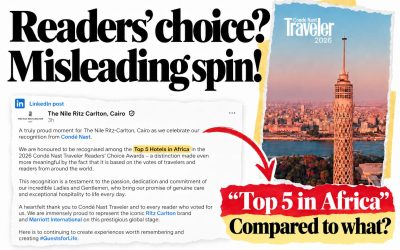
What got me thinking about this topic again was a post I saw shared by the Nile Ritz Carlton when I logged into LinkedIn this past week – a post boasting about “a truly proud moment” as this mediocre hotel in central Cairo was “honored to be recognized among the Top 5 Hotels in Africa in the 2026 Condé Nast Traveler Readers’ Choice Awards.”
I’m sorry, what? Top 5 Hotels in Africa??? The barely-renovated, stuck-in-the-1970s, brand-degrading Nile Ritz Carlton? Are you kidding me? Evidently not, because when I googled the 2026 Condé Nast Traveler Readers’ Choice Awards to see if this was true, sure enough it came up… well, sort of.
First of all, this sub-substandard property that I always recommend against anyone spending money on was NOT voted one of the “Top 5 Hotels in Africa.” That part was a lie that they were happy to tell because they can just claim it was an innocent wording mistake. When I looked at the actual category they supposedly ranked in, in reality it was “Top 5 Hotels in Africa Outside of Morocco and South Africa.”
But given the fact that I’ve been in the Nile Ritz Carlton many times and have also been in all of the other four- and five-star hotels in Greater Cairo hundreds of times, I fully expected to go on to find that there must have been some additional sub-category that would make this make sense, like “Top 5 Hotels in Africa Outside of Morocco and South Africa Located at This Specific Address.”
There was no such sub-categorization. Indeed, according to Condé Nast Traveler, their readers “chose” the Nile Ritz Carlton over dozens of other much nicer hotels in Egypt alone, much less all of the rest of Africa. I call bullshit!
Just in central Cairo, there are 10 hotels far nicer than the Nile Ritz Carlton. You expect me to believe that people prefer this shabby property over the Cairo St. Regis? Either of the two Four Seasons? And what about in the rest of Egypt – the Four Seasons Sharm el Sheikh, the Four Seasons San Stefano in Alexandria… seriously? I’m just not buying it.
But I think someone IS buying SOMETHING. Let’s just leave it at that.
Even if this is true and the “readers” of Condé Nast did indeed vote that the Nile Ritz Carlton is among the top 5 hotels in all of Africa outside of Morocco and South Africa, this just goes to prove that you cannot trust the opinions of people who come to a country like Egypt and stay in one property in each city and then try to claim that this is the best – or even worst – hotel in this city or that country.
How the hell would they know? They stayed in ONE hotel. Words like best and top are superlatives. They imply a comparison and a ranking. How can you compare a hotel to other hotels if you’ve never stayed in any other hotels in a place? And how many of Condé Nast’s readers came to Cairo to visit for 3 or 4 days and changed hotels multiple times?
Zero. That’s how many. And consequently, that’s also the confidence level we can apply to the incentivized reviews and heavily caveated rankings that legacy travel rags like Condé Nast put out these days. The modern truth is that those articles are not intended for the general traveling public to rely on them for travel research and advice. They’re intended for a PR manager to have a printable, shareable piece of content that they can show to their clueless boss and say, “Look, here’s an article about us in a formerly prominent travel magazine. I’m great at my job.”
So where does the Nile Ritz Carlton really rank among other hotels in Egypt. Forget all of Africa. It’s not even in the top 100 there. But what about in Egypt, or even just in Cairo? Well, the most accurate, honest, unbiased, trustworthy, and methodologically sound source for hotel quality in Egypt is the Best Hotels of Egypt list, which I started collecting data for in 2018 and publishing in 2022.
Why is this a more reliable source for doing your research on where to stay when visiting Egypt? Well, the Best Hotels of Egypt rankings are based on continuous evaluations by a small team of people who actually know the destination very well. We know all of the properties, not just one or two. We see how things are improving – or not – over time, not just a snapshot in time on one visit. And this list takes into account the experiences of anonymous secret shoppers at all of these properties too, not just reviewers who are already known to the management and PR teams.
So before you book the “perfect sanctuary” that some hack with an agenda is trying to sell you on, find out whether the source recommending it really knows what else is around the corner — or down the river. A thesaurus is no substitute for deep local knowledge and years of experience covering a destination’s tourism and hospitality scene independently.


